Astronomers using the NASA/ESA/CSA James Webb Space Telescope have observed six candidate galaxies with stellar masses as high as 1011 solar masses about...
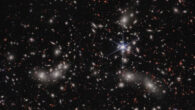
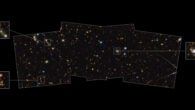
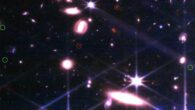
Webb astronomers estimate 50,000 near-infrared sources are represented in the new image of the huge galaxy megacluster Abell 2744.
This Webb image shows...
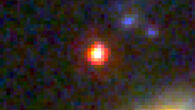
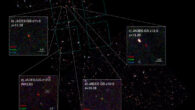
GHZ2/GLASS-z12, initially identified in the JWST GLASS survey, existed when the Universe was only 367 million years old (redshift z=12.117).
This image...
In the HighlY Interactive ParticlE Relics (HYPER) model, some time after the formation of dark matter in the early Universe, the strength of its interaction...
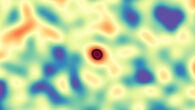
Using archival data from the Giant Metrewave Radio Telescope, astronomers have captured a radio signal at a specific wavelength known as the 21 cm line...
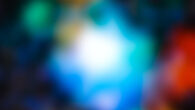
Astronomers using the NASA/ESA/CSA James Webb Space Telescope have detected three high-redshift galaxies with remarkable similarities to ‘green pea’...
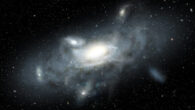
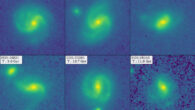
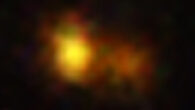
Astronomers using the NASA/ESA/CSA James Webb Space Telescope have spotted early galaxies with stellar bars — elongated features of stars stretching...
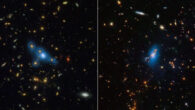
Intracluster light is diffuse light from stars that are gravitationally bound not to individual member galaxies, but to the halo of galaxy clusters. In...
This new image, captured by the NASA/ESA/CSA James Webb Space Telescope as part of the Prime Extragalactic Areas for Reionization and Lensing Science (PEARLS)...
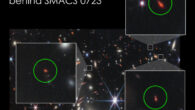
The light from these four galaxies has taken more than 13.4 billion years to reach us, as they date back to less than 400 million years after the Big Bang,...
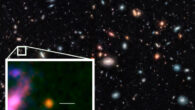
The two newfound galaxies, dubbed GLASS-z12 and GLASS-z10, existed approximately 350 and 450 million years after the Big Bang.
GLASS-z12 (redshift of 12.5)...
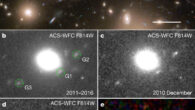
The newly-discovered core-collapse supernova, or Type II supernova, seen at a lookback time of approximately 11.5 billion years, is strongly lensed by...
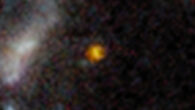
Nicknamed Quyllur, the newly-detected red supergiant candidate is so far away that its light has taken 10.7 billion years to reach Earth.
This Webb image...
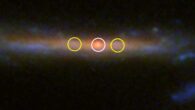
Astronomers say we may be witnessing a merger of two small galaxies just 400 million years after the Big Bang.
The galaxy cluster MACS0647 acts as a cosmic...
The red quasar the NASA/ESA/CSA James Webb Space Telescope observed, called SDSS J165202.64+172852.3 (SDSSJ1652 for short), resides in a very dense environment...
Astronomers using the X-SHOOTER instrument at ESO’s Very Large Telescope (VLT) have detected light from a gamma-ray burst at a redshift of 6.3, meaning...
The very first stars likely formed when the Universe was only 100 million years old. Known as Population III stars, these stellar objects were so massive...
The newly-discovered blue supergiant is much hotter than the Sun, and existed when the Universe was about 2.6 billion years old.
Left panel shows the color...
Astronomers from the University of Cambridge and elsewhere have analyzed the spectroscopic and photometric data from three instruments (NIRSpec, NIRISS...