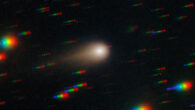
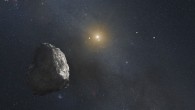
After 1I/ʻOumuamua and 2I/Borisov, 3I/ATLAS is the third object and the second comet from outside the Solar System confirmed.
This image from the Multi-Object...
NASA’s Perseverance rover has explored and sampled igneous and sedimentary rocks within Jezero crater to characterize early Martian geological processes...
Using the NASA/ESA/CSA James Webb Space Telescope, astronomers have found evidence for gaseous methane on the distant dwarf planet Makemake. Reported in...
Using the Gemini Multi-Object Spectrograph (GMOS) on the Gemini South telescope at NSF’s International Gemini Observatory in the Chilean Andes, astronomers...
Planetary researchers at Southwest Research Institute has completed a study detailing how a proposed spacecraft could fly by an interstellar comet, providing...
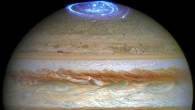
Jupiter hosts the brightest and most spectacular aurorae in the Solar System. Near its poles, these shimmering lights offer a glimpse into how the planet...
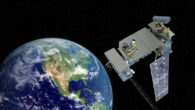
Using data collected by sensors on the U.S. Department of Defense Space Test Program Satellite 6 (STP-Sat6) in geostationary orbit, scientists have found...
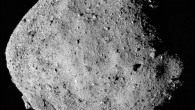
The new Polana collisional family in the Solar System’s main asteroid belt is the hypothesized origin of the near-Earth asteroids (101955) Bennu, which...
The first bodies to form in the Solar System acquired their materials from stars, the presolar molecular cloud and the protoplanetary disk. Asteroids that...
In a new study, a team of astronomers from Penn State and NASA’s Jet Propulsion Laboratory analyzed when and where human deep space transmissions would...
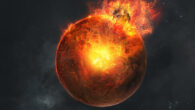
Although there is no evidence that microorganisms ever existed on Ceres, the results of a new study support theories that this dwarf planet may have once...
On July 20 and July 23, 2025, NASA’s Psyche spacecraft looked back toward home and captured images of Earth and our Moon from about 290 million km (180...
Using data from NASA’s Juno spacecraft, planetary researchers have detected a new type of plasma wave in the auroral zones above Jupiter’s north pole.
This...
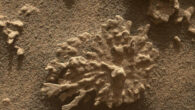
On July 24, 2025, the 4,608th Martian day, or Sol, of the mission, NASA’s Curiosity rover imaged wind-eroded rocks shaped like a piece of coral in the...
According to an analysis of the new images from the NASA/ESA Hubble Space Telescope, the nucleus of 3I/ATLAS is between 320 m (1,000 feet) and 5.6 km (3.5...
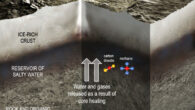
Radiolysis induced by Galactic cosmic rays could provide a viable energy source for microbial metabolism in the subsurface environments of rocky planetary...
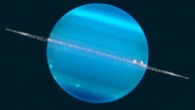
Uranus releases about 15% more energy than it receives from the Sun, according to two new papers published in the journal Monthly Notices of the Royal...
Discovered by the Large inclination Distant Objects (LiDO) survey and designated 2020 VN40, this trans-Neptunian object is the first confirmed body that...