Astronomy News

Feb 24, 2014 by News Staff

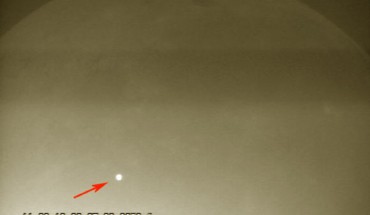
On September 11, 2013, an object with the mass of a small car hit the lunar surface in Mare Nubium, an ancient lava-filled basin with a darker appearance than its surroundings. The impact, the biggest seen to date, produced a bright flash and would have been easy to spot from the Earth. An image of the flash resulting from the impact of a large meteorite on the lunar surface on 11 September 2013, obtained with the 0.36-m-telescope in Sevilla, Spain....

Feb 21, 2014 by News Staff

According to astronomers led by Mr Paul Brook, a PhD student from the University of Oxford and CSIRO, a small pulsar dubbed PSR J0738-4042 is being pounded...

Feb 21, 2014 by News Staff

A team of astronomers led by Dr Alex Markowitz from the University of California, San Diego and the Karl Remeis Observatory in Bamberg, Germany, has discovered...

Feb 20, 2014 by News Staff

An international team of astronomers using NASA’s Nuclear Spectroscopic Telescope Array (NuSTAR) has revealed how stars blow up in supernova explosions. This...

Feb 19, 2014 by News Staff

A team of astronomers using the MPG/ESO 2.2-m telescope at ESO’s La Silla Observatory in Chile has captured a new image of the open star cluster...

Feb 18, 2014 by News Staff

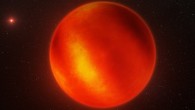
European astronomers led by Dr Federico Marocco from the University of Hertfordshire have discovered a brown dwarf with unusually red skies. Brown dwarf...

Feb 10, 2014 by News Staff

A multinational team of astronomers has reported the discovery of Abell2744 Y1 – one of the most distant galaxies ever found. This image shows the...

Feb 10, 2014 by News Staff

Astronomers led by Dr Stefan Keller of the Australian National University say they have discovered the oldest star ever seen in the Universe. This image,...

Feb 6, 2014 by News Staff

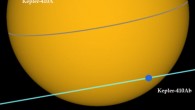
NASA astronomers announced the discovery of a strange super-Neptune circling a pair of orange and red dwarfs known as Kepler-413. This is an artist’s...

Jan 31, 2014 by News Staff

Researchers reporting in the Astrophysical Journal Letters have found that the majority of circumbinary planets – planets that orbit two stars –...

Jan 29, 2014 by News Staff

European scientists using ESO’s Very Large Telescope (VLT) have learned what the weather is like on the surface of one of the objects in a binary...

Jan 28, 2014 by News Staff

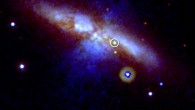
Astronomers using the Ultraviolet-Optical Telescope aboard NASA’s Swift spacecraft have snapped an image of a newly discovered stellar explosion...

Jan 25, 2014 by News Staff

An enormous black hole located in the center of the galaxy cluster RX J1532.9+3021 (RX J1532 for short) is one of the most powerful black holes in the...

Jan 23, 2014 by News Staff

An international group of astronomers led by Dr Vincent Van Eylen of Aarhus University, Denmark, has discovered a Neptune-sized extrasolar planet orbiting...

Jan 22, 2014 by News Staff

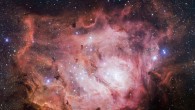
Astronomers using ESO’s VLT Survey Telescope in Chile have captured a new view deep inside the Lagoon Nebula, also known as Messier 8 or NGC 6523. This...

Jan 22, 2014 by News Staff

U.S. astronomers have captured a direct image of a very rare T-dwarf circling the nearby Sun-like star HD 19467. This is an artist’s impression of...

Jan 21, 2014 by News Staff

Our Milky Way Galaxy formed by expanding out from the center, suggests analysis of first data from the Gaia-ESO survey – the ground-based extension...

Jan 20, 2014 by News Staff

Using the 10-m Keck I Telescope at the W. M. Keck Observatory in Hawaii, an international group of astronomers has discovered a distant quasar illuminating...

Jan 20, 2014 by News Staff

By using the Atacama Large Millimeter/submillimeter Array (ALMA), Japanese astronomers have spotted strong evidence of a massive planet-forming disk around...

Jan 16, 2014 by News Staff

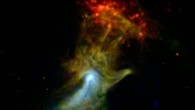
Astronomers using NASA’s Nuclear Spectroscopic Telescope Array (NuSTAR) have captured a stunning image of a stellar structure known as the ‘Hand...