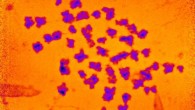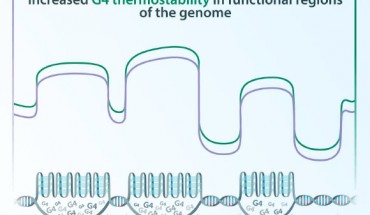
DNA usually forms the classic double helix shape — two strands wound around each other. But approximately 1% of the human genome has the ability to fold into four-stranded ‘quadruple helix’ DNA structures called G-quadruplexes (G4s). G4s regulate several key cellular processes (e.g., transcription) and have been hypothesized to participate in others. In new research, a team of scientists at Penn State University conducted the first genome-wide...



![Ternary structure of Polθ on a DNA/RNA primer-template: (A) Polθ polymerase; (B) DNA/RNA extension by Polθ and PolθΔL; (C) structure of Polθ:DNA/RNA:ddGTP; (D) superposition of Polθ:DNA/RNA (marine) and Polθ:DNA/DNA (orange, 4x0q); the fingers and thumb subdomains undergo reconfiguration; (E) superposition of Polθ:DNA/RNA (marine) and Polθ:DNA/DNA (orange, 4x0q) highlighting a 12-Å shift of K2181 (blue box; thumb) and a 4.4-Å shift of E2246 (gray box; palm); (F) superposition of nucleic acids and ddGTP from Polθ:DNA/RNA:ddGTP and Polθ:DNA/DNA:ddGTP structures; (G) top: electron density of ddGTP and 3′ primer terminus in Polθ:DNA/RNA structure; bottom: zoomed-in image of the superposition of active sites, illustrating a different conformation of ddGTP in the Polθ:DNA/RNA (blue) and Polθ:DNA/DNA (salmon) complexes; (H) interactions between ribose 2’-hydroxyl groups of the RNA template and residues in the Polθ:DNA/RNA structure; red dashed lines, hydrogen bonds; (I) DNA/RNA used for cocrystallization with Polθ and ddGTP (top); strong electron density is present for four base pairs [nucleotides located at positions 2 to 5 (underlined) of the DNA/RNA] and two base pairs resulting from an incorporated ddGMP (2’,3’ dideoxyguanosine monophosphate) (green; position 1) and a bound unincorporated ddGTP (red; position 0) in the active site (top); interactions between Polθ and nucleic acids in Polθ:DNA/RNA:ddGTP (bottom); interactions between residues and phosphate backbone, sugar oxygen, or nucleobase are shown in blue, yellow, and green, respectively; hydrogen bonds between Polθ and ribose 2’-hydroxyl groups are indicated (boxed residues); (J) interactions between Polθ and nucleic acids in Polθ:DNA/DNA:ddGTP (4x0q); color scheme identical to (I). Image credit: Chandramouly et al., doi: 10.1126/sciadv.abf1771.](https://cdn.sci.news/images/2021/06/image_9759-Polymerase-Theta-195x110.jpg)