Astronomy News

May 5, 2021 by Natali Anderson

Astronomers using NSF’s Karl G. Jansky Very Large Array (VLA) have captured new, high-resolution radio images of a massive star-forming region called W49A. This overlay shows radio (orange) and infrared images of the giant molecular cloud W49A, where new stars are being formed. Image credit: De Pree et al. / Sophia Dagnello, NRAO / AUI / NSF / Spitzer / NASA. W49A, also known as GAL 043.169+00.00, lies approximately 36,000 light-years away in the...

May 4, 2021 by News Staff

Astronomers using NASA’s Transiting Exoplanet Survey Satellite (TESS) exoplanet-hunting mission have detected the rising and decaying optical afterglow...

May 4, 2021 by Natali Anderson

Astronomers using data from NASA’s Fermi Gamma-ray Space Telescope have identified 14 candidate antistars — stars made of antimatter — in...

May 3, 2021 by Enrico de Lazaro

Abell 3827, a galaxy cluster located approximately 1.3 billion light-years away in the southern constellation of Indus, is so massive that its gravity...

Apr 30, 2021 by News Staff

Astronomers using Earth-based radar observations have measured some of the fundamental properties of the planet Venus: the precise length of a day, the...

Apr 30, 2021 by Natali Anderson

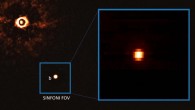
Astronomers using the NASA/ESA Hubble Space Telescope have imaged a Jupiter-sized, still-forming planet around the orange dwarf star PDS 70. This is the...

Apr 29, 2021 by Enrico de Lazaro

Astronomers using the Nicholas U. Mayall 4-m Telescope at Kitt Peak National Observatory have captured a breathtaking photo of an irregular dwarf galaxy...

Apr 29, 2021 by News Staff

Gravitational-wave and electromagnetic observations of neutron-star-black-hole mergers can provide precise local measurements of the Universe’s rate...

Apr 28, 2021 by News Staff

Astronomers using NASA’s Chandra X-ray Observatory have detected stable titanium, along with chromium and iron, blasting out from the center of the supernova...

Apr 28, 2021 by Natali Anderson

Astronomers have detected a hydroxyl radical (OH) — the neutral form of the hydroxide ion — in the dayside atmosphere of the ultrahot Jupiter...

Apr 27, 2021 by Enrico de Lazaro

Astronomers using the Multi Unit Spectroscopic Explorer (MUSE) instrument on ESO’s Very Large Telescope (VLT) have performed spectroscopic observations...

Apr 26, 2021 by News Staff

Dark matter with masses below 1 GeV can scatter, become captured, deposit annihilation energy, and increase the heat flow within extrasolar gas giants,...

Apr 26, 2021 by Enrico de Lazaro

The NASA/ESA Hubble Space Telescope has captured a striking new photo of a planetary nebula called the Necklace Nebula. This Hubble image shows the Necklace...

Apr 23, 2021 by News Staff

The NASA/ESA Hubble Space Telescope turned 31 this year, and for the occasion, the Hubble team has just released a beautiful image of the luminous blue...

Apr 22, 2021 by News Staff

Astronomers using the Atacama Large Millimeter/submillimeter Array (ALMA) have discovered a rotating dwarf galaxy 1/100th the size of the Milky Way in...

Apr 22, 2021 by News Staff

The newly-discovered stellar-mass black hole candidate is a binary companion to a nearby red giant called V723 Mon. An artist’s impression of the V723...

Apr 22, 2021 by News Staff

Astronomers using data ESA’s Gaia mission and NASA’s Near Earth Object Wide Field Infrared Survey Explorer (NEOWISE) have created a map of the outermost...

Apr 21, 2021 by News Staff

Using the Australian Square Kilometre Array Pathfinder (ASKAP), the Atacama Large Millimeter/submillimeter Array (ALMA), the NASA/ESA Hubble Space Telescope,...

Apr 21, 2021 by News Staff

Astronomers using the Murchison Widefield Array (MWA), a low-frequency radio telescope in Australia, have discovered a new long-period, low-luminosity...

Apr 20, 2021 by Natali Anderson

Astronomers using the Spectro-Polarimetric High-contrast Exoplanet Research (SPHERE) instrument on ESO’s Very Large Telescope have discovered and directly...