Astronomy News

Nov 16, 2020 by Natali Anderson

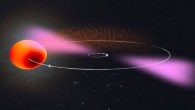
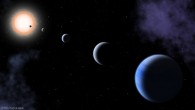
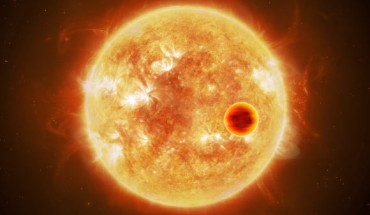
Astronomers using NASA’s Transiting Exoplanet Survey Satellite (TESS) and the Echelle SPectrograph for Rocky Exoplanets and Stable Spectroscopic Observations (ESPRESSO) instrument on ESO’s Very Large Telescope have revisited the planetary system LHS 1140 with its two known Earth-like planets. Their results show strong evidence for the signal of a third planet in the LHS 1140 system. An artist’s impression of the planetary system LHS 1140. Image...

Nov 16, 2020 by Enrico de Lazaro

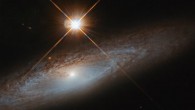
Astronomers using the NASA/ESA Hubble Space Telescope have captured an amazing new photo of a spiral galaxy called UGC 12588. This Hubble image shows the...

Nov 13, 2020 by Enrico de Lazaro

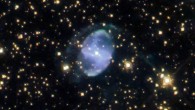
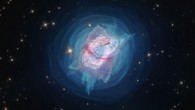
Astronomers using NASA’s Chandra X-ray Observatory have spotted a bubble of ultrahot gas at the center of a planetary nebula called IC 4593. This composite...

Nov 13, 2020 by News Staff

Several billion years ago, a short gamma-ray burst unleashed more energy in a half-second than our Sun will produce over its entire 10-billion-year lifetime....

Nov 12, 2020 by News Staff

HSC J023336-053022, a massive galaxy cluster located approximately 4 billion light-years away from Earth, is heating the material within it to hundreds...

Nov 12, 2020 by News Staff

The thermal evolution of rocky planets depends on the heat input from three long-lived radiogenic elements: potassium, thorium, and uranium. Concentrations...

Nov 10, 2020 by News Staff

The mean temperature of gas across the Universe has increased more than 10 times over the last 10 billion years and reached about 2 million Kelvin today,...

Nov 10, 2020 by News Staff

Using computer simulations, an international team of astronomers has studied the weather conditions on K2-141b, an Earth-size exoplanet with supersonic...

Nov 9, 2020 by News Staff

Astronomers using the Low-Frequency Array (LOFAR) radio telescope have discovered a new brown dwarf, a substellar object not quite massive enough to fuse...

Nov 9, 2020 by News Staff

Astronomers using the CHIME (Canadian Hydrogen Intensity Mapping Experiment) and FAST (Five-hundred-meter Aperture Spherical radio Telescope) telescopes...

Nov 9, 2020 by Enrico de Lazaro

SDSS J0901+1814, a giant galaxy cluster located 3.9 billion light-years away in the constellation of Cancer, is so massive that its gravity distorts and...

Nov 5, 2020 by News Staff

Most stars in the central 1,000 light-years of the Milky Way’s hub formed when it was swollen with infalling gas more than 10 billion years ago, according...

Nov 3, 2020 by Enrico de Lazaro

Two massive lenticular galaxies, NGC 2292 and NGC 2293, approached one another too closely in the distant past, gravity causing them to affect each other...

Nov 2, 2020 by News Staff

Barnard’s star, a 10-billion-year-old red dwarf just 6 light-years from Earth, is still very active and potentially destructive for the atmospheres of...

Nov 2, 2020 by News Staff

Astronomers using ESO’s Very Large Telescope (VLT) have captured a beautiful image of a planetary nebula called the Skull Nebula. This image, taken by...

Nov 2, 2020 by Enrico de Lazaro

The NASA/ESA Hubble Space Telescope has produced an outstanding image of a spiral galaxy called UGCA 193. This Hubble image shows the edge-on spiral galaxy...

Oct 30, 2020 by Enrico de Lazaro

Astronomers from the OGLE (Optical Gravitational Lensing Experiment) project have discovered a Mars- to Earth-mass free-floating, or rogue, planet through...

Oct 29, 2020 by News Staff

A team of astronomers from Northern Arizona University and Lowell Observatory has discovered cometary activity on 2014 OG392, a distant centaur object...

Oct 28, 2020 by News Staff

Using high sensitivity spectroscopic observations from the Atacama Large Millimeter/submillimeter Array (ALMA), astronomers have detected a small cyclic...

Oct 28, 2020 by News Staff

Supermassive black holes are characterized by just two numbers: mass and spin, but have a critical influence on the formation and evolution of galaxies....