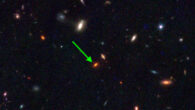
Astrononomers using the NASA/ESA/CSA James Webb Space Telescope have detected that GS-10578, a massive, quiescent galaxy at redshift of 3.064 (look-back...
It’s 7 billion years ago, and the Universe’s heyday of star formation is beginning to slow. What might our Milky Way Galaxy have looked like at that...
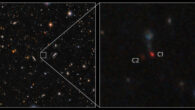
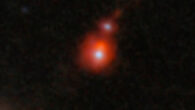
Using the Atacama Large Millimeter/submillimeter Array (ALMA) and the Subaru Telescope, astronomers have discovered a pair of merging gas-rich galaxies...
In a paper published today in the Astronomical Journal, astronomers analyzed the evolution of massive galaxies at redshifts of 4-8 selected from the JWST...
Astronomers using the NASA/ESA/CSA James Webb Space Telescope have spotted at least five young globular clusters within SPT 0615-JD1 (also known as the...
Astronomers have discovered a pair of merging quasars seen only 900 million years after the Big Bang. Not only is this the most distant pair of merging...
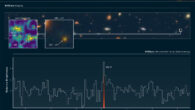
Astronomers using the NIRSpec (Near-Infrared Spectrograph) instrument onboard the NASA/ESA/CSA James Webb Space Telescope have obtained the spectrum of...
Astronomers using the NASA/ESA/CSA James Webb Space Telescope have found evidence for an ongoing merger of two galaxies and their central black holes —...
Astronomers at MIT have discovered thee extremely ancient stars in the Milky Way’s halo, a cloud of stars that envelopes the entire main Galactic disk....
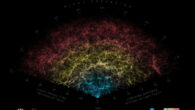
To study dark energy’s effects over the past 11 billion years, the Dark Energy Spectroscopic Instrument (DESI) has created the largest 3D map of our...
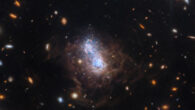
Astronomers using the NASA/ESA/CSA James Webb Space Telescope have captured a spectacular image of I Zwicky 18 (I Zw 18 for short), the archetypal extremely...
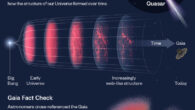
The new map, dubbed Quaia, includes around 1,295,502 quasars from across the visible Universe and could help astronomers better understand the properties...
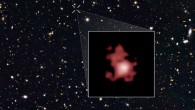
GN-z11 is an exceptionally luminous galaxy that existed when our Universe was only 420 million years old, making it one of the earliest and most distant...
The reionization of the Universe occurred some 500 to 900 million years after the Big Bang. It represents the transformation of neutral hydrogen into ionized...
The black hole in the newly-discovered quasar SMSS J052915.80-435152.0 (hereafter called J0529-4351) accretes around one solar mass per day onto an existing...
The formation of galaxies by gradual hierarchical co-assembly of baryons and cold dark matter halos is a fundamental paradigm underpinning modern astrophysics...
New insights from the NASA/ESA/CSA James Webb Space Telescope upend theories of how black holes shape the cosmos, challenging classical understanding that...
Using the Mid-InfraRed Instrument (MIRI) onboard the NASA/ESA/CSA James Webb Space Telescope, astronomers have captured a spectacular image of N79, a region...
Astronomers using the NASA/ESA/CSA James Webb Space Telescope have detected a small and vigorous black hole in GN-z11, an exceptionally luminous galaxy...