Paleontology News

Apr 4, 2017 by News Staff

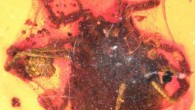
A blood-engorged nymphal tick of the genus Amblyomma surrounded by fossilized mammalian erythrocytes (red blood cells) has been discovered in a piece of 15-45-million-year-old amber. The discovery is reported March 20 in the online edition of the Journal of Medical Entomology. This blood-engorged nymphal hard tick Amblyomma sp. (length – 2.5 mm) found as a fossil in Dominican amber shows two small holes in its back, as if it were just picked...

Apr 2, 2017 by News Staff

Paleontologists have unveiled a remarkable new species of tyrannosaurine dinosaur from the Late Cretaceous epoch — a cousin of the fearsome predator...

Mar 29, 2017 by Natali Anderson

A group of paleontologists from the University of Queensland and James Cook University has documented the most diverse assemblage of dinosaur tracks in...

Mar 24, 2017 by News Staff

Exceptionally well-preserved specimens unearthed in Early Cretaceous sediments of Mongolia belong to an ancient, dinosaur-era relative of the living plant...

Mar 23, 2017 by News Staff

A fossil crustacean, discovered by a University of Leicester-led team of paleontologists, has been named Cascolus ravitis in honor of the naturalist and...

Mar 22, 2017 by News Staff

A team of paleontologists from the University of Cambridge and the Natural History Museum, London, UK, has proposed radical changes to the dinosaur family...

Mar 16, 2017 by News Staff

A new study led by the American Museum of Natural History (AMNH) provides the strongest evidence to date that sharks arose from a group of bony fishes...

Mar 15, 2017 by Natali Anderson

An international team of paleontologists from the Nordic Center for Earth Evolution and the Swedish Museum of Natural History has unearthed uniquely well-preserved...

Mar 10, 2017 by News Staff

It was the power of the eyes — not the limbs — that first led our ancient aquatic ancestors to make the leap from water to land, according...

Mar 8, 2017 by News Staff

New research by Brockport College Professor Judy Massare and University of Manchester paleontologist Dean Lomax confirms that two species of ichthyosaurs...

Mar 3, 2017 by News Staff

According to a new study published in the journal PLoS Genetics, dwindling populations created a ‘mutational meltdown’ in the genomes of the last wooly...

Mar 3, 2017 by News Staff

An international team of paleobiologists has uncovered the fossil of a 105-million-year-old gymnosperm pollinating beetle, named Darwinylus marcosi. The...

Mar 1, 2017 by News Staff

An international team of paleontologists has discovered in Quebec, Canada, the oldest physical evidence of life on Earth — fossils that date back...

Feb 24, 2017 by Natali Anderson

The fossilized leg bones of a giant penguin that lived 61 million years ago have been discovered in New Zealand. Artist’s impression of a group of Waimanu...

Feb 23, 2017 by Enrico de Lazaro

A prehistoric monster worm that terrorized the Devonian seas some 400 million years ago has been identified by an international team of paleontologists...

Feb 22, 2017 by Enrico de Lazaro

Adult and juvenile fossil specimens of Isostylomys laurdillardi, a giant rodent that lived in South America between 9 and 6.8 million years ago (Miocene...

Feb 17, 2017 by News Staff

Hatzegopteryx, a flying reptile with a 10-m wingspan and a mass of 220 kg, was the dominant predator in what is now Romania between 72-66 million years...

Feb 16, 2017 by News Staff

When you’re a small pre-mammalian creature, sometimes the only way to protect yourself against fearsome predators like saber-toothed carnivores is to...

Feb 15, 2017 by News Staff

The first ever evidence of live birth in a group of animals previously thought only to lay eggs has been discovered by an international team of paleontologists...

Feb 6, 2017 by News Staff

Paleontologists have unearthed the remains of a previously unknown slug-like creature that lived during the Early Ordovician epoch, 478 million years ago....