Biology News

Mar 3, 2016 by News Staff

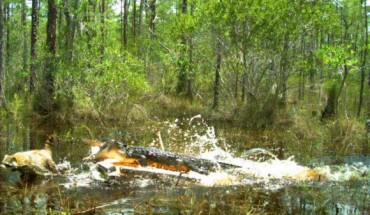
Long-legged wading birds that nest above resident American alligators (Alligator mississippiensis) for protection from mammalian nest predators may also provide a source of food for the alligators living in the Everglades, Florida, says a team of researchers led by University of Florida scientist Lucas Nell. An American alligator (Alligator mississippiensis) attempting to catch a raccoon (Procyon lotor) on a bait station in southwest Florida. Image...
Mar 2, 2016 by News Staff

A new study in rats led by Dr. Beth Allison of the University of Cambridge, UK, suggests that the aging clock begins ticking even before we are born and...

Feb 27, 2016 by Natali Anderson

A new species of the plant genus Rafflesia – R. consueloae — has been described from the Philippine Island of Luzon by a team of scientists led...

Feb 24, 2016 by Sergio Prostak

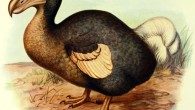
According to a new study in the Zoological Journal of the Linnean Society, an extinct bird known as the dodo (Raphus cucullatus) was in fact relatively...

Feb 23, 2016 by News Staff

According to a team of ornithologists led by University of Vienna scientist Didone Frigerio, laying eggs and raising chicks can have a negative effect...

Feb 23, 2016 by Enrico de Lazaro

An international team of scientists from Czech Republic, France and Germany has identified a cryptic new species of grass snake living in the North African...

Feb 20, 2016 by News Staff

Zooplanktonic sea butterflies (Limacina helicina) ‘fly’ underwater using the same technique as tiny flying insects, beating their wings in a figure-of-eight...

Feb 18, 2016 by News Staff

A team of scientists, led by Dr. Reed Shabman of the J. Craig Venter Institute and Prof. Christopher Basler of the Icahn School of Medicine at Mount Sinai,...

Feb 12, 2016 by Natali Anderson

A team of biologists and robotic researchers from Australia and Germany has solved a mystery of how wasps make sure that they find their way home. The...

Feb 10, 2016 by News Staff

According to a group of researchers at the University of Sussex in Brighton, UK, domestic horses (Equus caballus) are able to distinguish between positive...

Feb 10, 2016 by Enrico de Lazaro

Various species and subspecies of canids (wolves, coyotes, etc.) have distinguishing repertoires of howling, according to a team of scientists who analyzed...

Feb 9, 2016 by Natali Anderson

According to a study published in the journal eLife, cyanobacteria cells act as spherical microlenses, allowing the cell to see a light source and move...

Feb 5, 2016 by Enrico de Lazaro

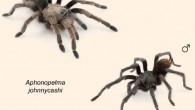
A team of researchers, directed by Dr. Chris Hamilton of the Auburn University Museum of Natural History, has discovered a previously unknown species of...

Feb 4, 2016 by News Staff

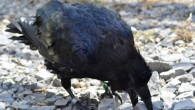
According to a new study published in the journal Nature, ravens (Corvus corax) share human ability to think abstractly about other minds, adapting their...

Feb 4, 2016 by Natali Anderson

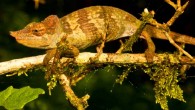
A team of scientists led by Dr. Michele Menegon of the Museo delle Scienze in Trento, Italy, has described a previously undocumented species of chameleon...

Feb 2, 2016 by News Staff

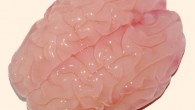
A variety of hypotheses on how the brain folds have been proposed but none have been directly used to make testable predictions. Now, a group of scientists...

Jan 28, 2016 by Sergio Prostak

A shape-shifting frog from Ecuador, a giant virus from Siberia, and a bioluminescent shark are among the twenty most bizarre species discovered in the...

Jan 28, 2016 by Natali Anderson

A shape-shifting frog from Ecuador, a giant virus from Siberia, a bioluminescent shark, a ruby seadragon, and the world’s smallest snail are among the...

Jan 26, 2016 by Natali Anderson

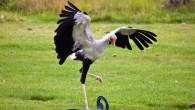
According to a new study published this week in the journal Current Biology, Secretary birds can kick with 195 Newtons, which is equivalent to about 5...

Jan 25, 2016 by News Staff

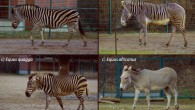
In a study published online in the journal PLoS ONE, scientists found that zebra stripes cannot be involved in allowing the animals to blend in with the...