Biology News

Dec 19, 2014 by News Staff

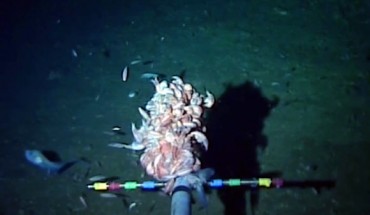
The world’s deepest fish has been captured on film by scientists from the University of Hawaii, Schmidt Ocean Institute and the University of Aberdeen using a diving vehicle called Hadal-Lander. This snailfish (bottom-left of the image) at 8,145 meters is a record for the deepest fish ever filmed; small amphipods are visible in the center. Image credit: University of Aberdeen. The video footage shows a type of snailfish at depths of 8,145 meters...

Dec 19, 2014 by News Staff

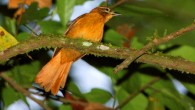
While tracking a population of golden-winged warblers (Vermivora chrysoptera) in Tennessee in April 2014, a team of ornithologists led by Dr Henry Streby...

Dec 18, 2014 by News Staff

Prof Charles Messing from the Nova Southeastern University’s Oceanographic Center is auctioning off the naming rights on eBay to a new species of...

Dec 17, 2014 by Enrico de Lazaro

An international group of entomologists led by Dr Marco Bologna from the University Roma Tre, Italy, has described a new species in the beetle genus Hycleus. Hycleus...

Dec 16, 2014 by News Staff

A group of marine biologists headed by Dr Robert Vrijenhoek from the Monterey Bay Aquarium Research Institute has described five new species of deep water...

Dec 13, 2014 by News Staff

A team of marine biologists led by Dr Robert Vrijenhoek from the Monterey Bay Aquarium Research Institute has discovered a new species of bone-devouring...

Dec 11, 2014 by News Staff

Dragonflies move like ballet dancers when they hunt, according to new research by entomologists from the University of Arizona, Howard Hughes Medical Institute,...

Dec 10, 2014 by News Staff

According to a new study carried out by ornithologists at the University of British Columbia, Canada, hummingbirds are surprisingly sensitive to movements...

Dec 5, 2014 by News Staff

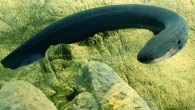
A new study carried out by Dr Kenneth Catania from Vanderbilt University in Nashville, TN, reveals that an electric fish known the electric eel (Electrophorus...

Dec 4, 2014 by News Staff

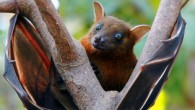
An international team of scientists from Israel and Thailand has found that Old World fruit bats, which have always been classified as non-echolocating,...

Dec 4, 2014 by News Staff

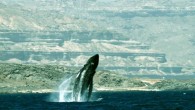
According to a new study published in the journal PLoS ONE, a small, non-migratory population of humpback whales (Megaptera novaeangliae) in the Arabian...

Dec 3, 2014 by News Staff

Human eyes can detect light at wavelengths in the visual spectrum; other wavelengths, such as infrared and ultraviolet, are supposed to be invisible, but...

Nov 30, 2014 by Natali Anderson

Brazilian ornithologists Dr Juan Mazar Barnett and Dr Dante Buzzetti of the Center for Ornithological Studies in São Paulo have discovered a new species...

Nov 25, 2014 by News Staff

An international group of ornithologists from the United States and Indonesia led by Dr Berton Harris of Princeton University has described a new species...

Nov 24, 2014 by News Staff

Scientists from the Monterey Bay Aquarium Research Institute using their remotely operated vehicle Doc Ricketts have filmed a rare and bizarre-looking...

Nov 19, 2014 by News Staff

About 80 million bacteria are transferred during a single 10-second kiss, says a group of researchers from the Netherlands. Partners who kiss each other...

Nov 17, 2014 by News Staff

An international team of scientists from Germany and France has described a new species of gecko that lives in a karstic limestone massif called Montagne...

Nov 13, 2014 by Enrico de Lazaro

According to a new study published in the journal Plant and Cell Physiology, hemoglobin found in a variety of beetroot called the sugar beet (Beta vulgaris...

Nov 8, 2014 by News Staff

Using a molecular dataset consisting of 144 carefully chosen species of insects, researchers from the 1KITE (1,000 Insect Transcriptome Evolution) project...

Nov 7, 2014 by News Staff

Mexican free-tailed bats (Tadarida brasiliensis) compete for prey by jamming each other’s sonar, says a new study carried out by Wake Forest University...