Astronomy News

Oct 29, 2015 by News Staff

In 2014, NASA’s Nuclear Spectroscopic Telescope Array (NuSTAR) and the agency’s Swift satellite observed an X-flare from the supermassive black hole in Markarian 335, a galaxy located 324 million light-years away in the constellation Pegasus. The observations allowed astronomers to link a shifting corona to an X-ray flare for the first time. A supermassive black hole is depicted in this artist’s concept, surrounded by a swirling disk of material...

Oct 28, 2015 by News Staff

Using data from the VISTA Variables in the Via Lactea Survey (VVV) ESO Public Survey, astronomers have discovered a previously unknown component of the...

Oct 26, 2015 by Natali Anderson

In a paper in the journal Science Advances, astronomers report the detection of 21 different organic molecules in gas from Comet Lovejoy, including the...

Oct 26, 2015 by News Staff

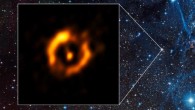
The NASA/ESA/Hubble Heritage Team has released a stunning image of a complex star system known as DI Cha. This image from Hubble’s Advanced Camera for...

Oct 22, 2015 by News Staff

Using observations from the NASA/ESA Hubble Space Telescope, astronomers have discovered over 250 ultra-faint dwarf galaxies in three extremely distant...

Oct 22, 2015 by News Staff

The newly-released photographic mosaic of our Galaxy is the largest astronomical image ever created, according to a team of astronomers from Germany and...

Oct 22, 2015 by News Staff

An international team of astronomers has uncovered evidence of a minor planet being torn apart as it spirals around WD 1145+017, a white dwarf located...

Oct 22, 2015 by News Staff

Using a trio of X-ray telescopes, astronomers have observed material being blown away from a supermassive black hole after it tore a star apart. The event...

Oct 21, 2015 by News Staff

New observations from ESO’s Very Large Telescope have revealed that a binary star system called VFTS 352 is among the most extreme and strangest yet...

Oct 21, 2015 by News Staff

When the Solar System was born about 4.6 billion years ago only 8% of the potentially habitable terrestrial exoplanets that will ever form in the Universe...

Oct 20, 2015 by News Staff

A team of astronomers at the Leibniz Institute for Astrophysics Potsdam, Germany, has created a video that shows the evolution of stellar spots on the...

Oct 20, 2015 by News Staff

A team of U.S. astronomers has made a surprising discovery using data collected by NASA’s Kepler/K2 mission: a star called WASP-47, a previously known...

Oct 19, 2015 by Natali Anderson

The NASA/ESA Hubble Space Telescope has captured this vivid image of Messier 94. This image from Hubble’s Wide Field and Planetary Camera 2 shows the...

Oct 14, 2015 by News Staff

This image from the Wide Field Imager, a camera installed on the MPG/ESO 2.2-m telescope at ESO’s La Silla Observatory in Chile, shows part of the huge...

Oct 14, 2015 by News Staff

A team of astronomers from NASA’s Goddard Space Flight Center, the agency’s Jet Propulsion Laboratory, and the University of California, Berkeley,...

Oct 13, 2015 by News Staff

Using one of the world’s greatest radio observatories, National Radio Astronomy Observatory’s Very Large Array (VLA), a group of astronomers has found...

Oct 12, 2015 by News Staff

The Hubble team has released a stunning photo taken by the NASA/ESA Hubble Space Telescope of a galaxy known as NGC 4639. This Hubble image shows the barred...

Oct 8, 2015 by News Staff

Using images from ESO’s Very Large Telescope (VLT) in Chile and the NASA/ESA Hubble Space Telescope, a team of astronomers has discovered unique structures...

Oct 8, 2015 by News Staff

A team of astronomers from the University of Washington and NASA Astrobiology Institute’s Virtual Planetary Laboratory has created the ‘Habitability...

Oct 6, 2015 by News Staff

A team of astronomers from Chile, the United Kingdom, and the Netherlands, has found a new, highly accurate way to measure the mass of young pulsars. This...