Other Sciences News

Apr 25, 2016 by News Staff

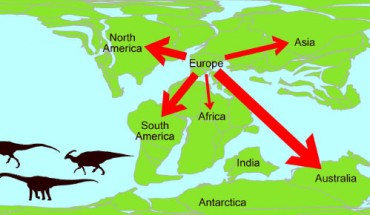
A team of paleontologists led by University of Leeds scientist Dr. Alexander Dunhill has used the so-called ‘Network Theory’ to visually depict the movement of dinosaurs around the world during the Mesozoic era (252 to 66 million years ago) – including a curious exodus from Europe during the Early Cretaceous (146 to 100 million years ago). A map showing the migration of dinosaurs from Europe during the Early Cretaceous. Image credit: Alex Dunhill...

Apr 20, 2016 by News Staff

A novel technology being developed by a team of researchers at Binghamton University has delivered outstanding results over the ability to identify persons...

Apr 19, 2016 by News Staff

A new tool called the Geographic Population Structure (GPS), which converts DNA data into its ancestral coordinates, has pinpointed origin of Yiddish speakers,...

Apr 19, 2016 by News Staff

New research published in the journal Frontiers in Ecology and the Environment documents animal species prevalent in the human-free Chernobyl Exclusion...

Apr 18, 2016 by News Staff

Professor Takao Someya’s research group at the University of Tokyo’s Graduate School of Engineering has developed an ultraflexible ‘e-skin’...

Apr 12, 2016 by News Staff

Historians have long debated whether the first major phase of compilation of Biblical texts took place before or after the destruction of Jerusalem and...

Apr 11, 2016 by News Staff

A new study published in the American Journal of Physical Anthropology suggests that the transfer of infectious pathogens between populations of Neanderthals...

Apr 9, 2016 by News Staff

An international team of researchers, led by Dr. Thomas Pichler from the University of Vienna, has presented a novel method to grow stable, ultra-long...

Apr 8, 2016 by Natali Anderson

Neanderthal Y-chromosome genes disappeared from the genome of modern humans long ago, suggests a new study published this week in the American Journal...

Apr 5, 2016 by Enrico de Lazaro

A single-molecule diode, the world’s smallest, has been created by a team of researchers from Ben-Gurion University of the Negev and the University of...

Apr 4, 2016 by News Staff

A new study published today in the Proceedings of the National Academy of Sciences reveals that the circulation in fresh water or salty oceans on terrestrial...

Mar 31, 2016 by News Staff

A team of scientists at KTH Royal Institute of Technology in Stockholm, Sweden, has developed transparent wood that could be used in building materials...

Mar 30, 2016 by Enrico de Lazaro

According to a multinational team of scientists, Homo floresiensis — a primitive hominin species discovered in the Late Pleistocene sediments at...

Mar 29, 2016 by Enrico de Lazaro

Dr. David Reich from Harvard Medical School and his colleagues have produced a world map of Denisovan and Neanderthal ancestry in 120 diverse populations....

Mar 28, 2016 by News Staff

A team of scientists, led by Ohio State University cognitive researcher Prof. Aleix Martinez, has identified a universal facial expression that is interpreted...

Mar 24, 2016 by Sergio Prostak

Fieldwork at the Pliocene site of Kantis, Kenya, has yielded fossilized teeth and forearm bone attributable to Australopithecus afarensis, a hominid species...

Mar 21, 2016 by News Staff

According to an international team of physical chemists, led by University of Luxembourg researcher Prof. Alexandre Tkatchenko, intermolecular attractions...

Mar 18, 2016 by News Staff

Residents of the Pacific islands of Melanesia share fragments of genetic code with two early human species: Denisovans, whose remains were found in Siberia,...

Mar 17, 2016 by News Staff

Speakers of the Nheengatú language talk about time of day by pointing at where the Sun would be in the sky at that particular time, according to a study...

Mar 15, 2016 by Enrico de Lazaro

The first analysis of nuclear DNA from Sima de los Huesos hominins, conducted by Dr. Matthias Meyer of the Max Planck Institute for Evolutionary Anthropology...