Astronomy News

Dec 24, 2018 by News Staff

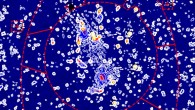
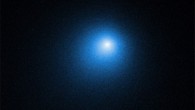
Astronomers using the Atacama Large Millimeter/submillimeter Array (ALMA) captured the radio image of 46P/Wirtanen on December 2, 2018, when the comet was about 10.3 million miles (16.5 million km) from Earth. ALMA image of 46P/Wirtanen taken on December 2, 2018, as the comet approached Earth. The image shows the concentration and distribution of HCN molecules near the center of the comet’s coma. Image credit: ALMA / ESO / NAOJ / NRAO / M. Cordiner...

Dec 21, 2018 by News Staff

The NASA/ESA Hubble Space Telescope and NASA’s Stratospheric Observatory for Infrared Astronomy (SOFIA) snapped stunning images of a short-period comet...

Dec 20, 2018 by News Staff

Dark matter is a mysterious substance that makes up about 85% of the matter in the Universe. It does not emit any kind of electromagnetic radiation and...

Dec 19, 2018 by News Staff

A young star in the midst of a dramatic growth phase has been observed with the help of ESA’s Gaia satellite and NASA’s Near-Earth Object Wide-field...

Dec 18, 2018 by News Staff

According to a Swinburne University of Technology-led study, the newly-discovered relic cloud of gas is unpolluted by stars even 1.5 billion years after...

Dec 18, 2018 by News Staff

Carnegie Institution astronomer Dr. Scott S. Sheppard, University of Hawaii’s Dr. David Tholen and Northern Arizona University’s Dr. Chad Trujillo...

Dec 17, 2018 by Enrico de Lazaro

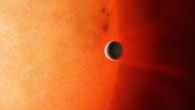
Astronomers have discovered a frozen exoplanet nearly the size of Neptune orbiting the quiet G9-type dwarf star K2-263. An artist’s impression of the...

Dec 15, 2018 by News Staff

On Sunday, December 16, 2018, comet 46P/Wirtanen will make a close pass of Earth. The comet will be at its closest distance to our planet in over four...

Dec 14, 2018 by News Staff

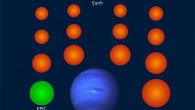
Extrasolar ‘Neptunes’ are exoplanets with masses and radii similar to those of the ice giants in the Solar System. In 2015, astronomers using the NASA/ESA...

Dec 14, 2018 by News Staff

While observing a massive protostar called G11.92-0.61 MM 1, a research team led by University of Leeds astronomers discovered it was not in fact one stellar...

Dec 13, 2018 by News Staff

Astronomers using the Atacama Large Millimeter/submillimeter Array (ALMA) have conducted one of the deepest surveys ever of protoplanetary disks —...

Dec 13, 2018 by News Staff

Approximately 2.6 million years ago (Pliocene epoch), a tsunami of cosmic energy from a massive supernova or a series of them about 150 light-years away...

Dec 10, 2018 by News Staff

A new image from the NASA/ESA Hubble Space Telescope shows the core and the innermost parts of the spiral arms of a galaxy called Messier 100. This Hubble...

Dec 7, 2018 by News Staff

In October 2017, a fast moving object of extrasolar origin, named ‘Oumuamua, was discovered close to the Earth with a ground-based telescope in Hawai’i....

Dec 7, 2018 by News Staff

An international team of astronomers has detected helium escaping from the upper atmosphere of HAT-P-11b, a Neptune-mass exoplanet located in the constellation...

Dec 5, 2018 by News Staff

The standard cosmological model known as LambdaCDM can only explain 5% of the observable Universe. The remaining 95% is famously made up almost entirely...

Dec 3, 2018 by Enrico de Lazaro

Astronomers using the Atacama Large Millimeter/submillimeter Array (ALMA) have spotted comet-like stars in a young star cluster called Westerlund 1. This...

Dec 3, 2018 by News Staff

A new series of daytime images of Europa from the Atacama Large Millimeter/submillimeter Array (ALMA) has helped astronomers create first global thermal...

Nov 30, 2018 by News Staff

Astronomers believe that our Universe began forming the first stars when it was a few hundred million years old. Since then, the Universe has become a...

Nov 29, 2018 by News Staff

Globular clusters are ancient groups of hundreds of thousands or even millions of stars, gravitationally bound into a single structure about 100-200 light-years...