Astronomy News

Sep 8, 2022 by News Staff

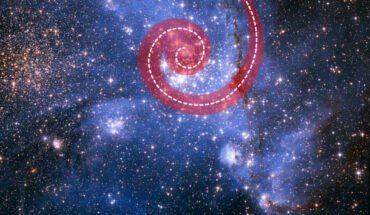
Astronomers using the Multi Unit Spectroscopic Explorer (MUSE) instrument on ESO’s Very Large Telescope (VLT) and the NASA/ESA Hubble Space Telescope have spotted young stars that are spiraling into the center of NGC 346, a massive star cluster in the Small Magellanic Cloud. The unusual shape of the open cluster NGC 346 is partly due to stars and gas spiraling into the center of the cluster in a river-like motion; the red spiral superimposed on...

Sep 7, 2022 by Natali Anderson

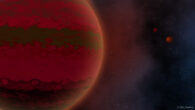
Using the spectral data from the NASA/ESA/CSA James Webb Space Telescope, astronomers have found evidence for silicate clouds as well as water, methane,...

Sep 7, 2022 by News Staff

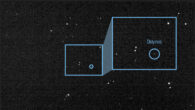
The Didymos Reconnaissance and Asteroid Camera for Optical navigation (DRACO) aboard NASA’s Double Asteroid Redirection Test (DART) spacecraft has captured...

Sep 7, 2022 by Natali Anderson

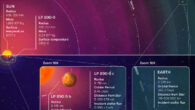
Astronomers using NASA’s Transiting Exoplanet Survey Satellite and the SPECULOOS (Search for habitable Planets EClipsing ULtra-cOOl Stars) telescopes...

Sep 6, 2022 by Enrico de Lazaro

The significant gamma-ray emission is coming from a population of millisecond pulsars within the Sagittarius dwarf spheroidal galaxy, an elliptical loop-shaped...

Sep 6, 2022 by News Staff

The Tarantula Nebula, a turbulent star-birth region located in the Large Magellanic Cloud, hosts thousands of young and still-forming stars, many revealed...

Sep 5, 2022 by News Staff

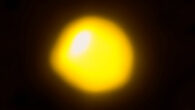
A team of astronomers from the University of Jena and elsewhere has analyzed pre-telescopic records on star color from Europe, the Mediterranean, West...

Sep 5, 2022 by Enrico de Lazaro

LEDA 2073461 and SDSS J115331.86+360024.2 look like they’re interacting, but they are actually separated by millions of light-years. This Hubble image...

Sep 2, 2022 by Sergio Prostak

Using the NASA/ESA/CSA James Webb Space Telescope, astronomers have captured a direct image of HIP 65426b, an extrasolar gas giant about 6 to 12 times...

Sep 1, 2022 by Natali Anderson

The newly-discovered blue supergiant is much hotter than the Sun, and existed when the Universe was about 2.6 billion years old. Left panel shows the color...

Aug 30, 2022 by News Staff

Astronomers using the Atacama Large Millimeter/submillimeter Array (ALMA) and the NASA/ESA Hubble Space Telescope have observed SDSS J144845.91+101010.5,...

Aug 29, 2022 by Natali Anderson

Sagittarius B1, a region close to the center of our Milky Way Galaxy, hosts more than 100,000  solar masses of young stars. This image, taken with the...

Aug 29, 2022 by Enrico de Lazaro

New data from the NASA/ESA/CSA James Webb Space Telescope and the NASA/ESA Hubble Space Telescope compliment each other to provide a comprehensive view...

Aug 26, 2022 by Natali Anderson

Earendel is a B-type giant star, a luminous blue variable star, or even a binary system with an extremely hot primary member, according to new observations...

Aug 25, 2022 by News Staff

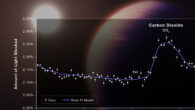
Carbon dioxide is a key chemical species that is found in a wide range of planetary atmospheres. This transmission spectrum of WASP-39b was captured by...

Aug 24, 2022 by Natali Anderson

Astronomers using NASA’s Transiting Exoplanet Survey Satellite (TESS) and the SPIRou spectropolarimeter on the 3.6-m Canada-France-Hawaii telescope have...

Aug 23, 2022 by News Staff

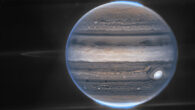
The two new images of Jupiter were taken with Webb’s Near-Infrared Camera (NIRCam), which has three specialized infrared filters that showcase details...

Aug 23, 2022 by News Staff

Carbon monoxide is ultra-bright and extremely common in protoplanetary disks, making it a prime target for astronomers. But a huge chunk of carbon monoxide...

Aug 22, 2022 by Natali Anderson

Astronomers from the University of Cambridge and elsewhere have analyzed the spectroscopic and photometric data from three instruments (NIRSpec, NIRISS...

Aug 22, 2022 by Enrico de Lazaro

R136a1 has a mass between 170 and 230 solar masses, according to an analysis of optical data from the speckle imager Zorro mounted on the 8.1-m Gemini...