Astronomy News

Jun 21, 2021 by News Staff

Astrophysical observations show that supermassive black holes exist when the Universe is just 800 million years old after the Big Bang (just 6% of its current age). The origin of these compact objects is still a mystery; in particular, it is extremely puzzling how they could become so massive in such a cosmologically short time interval. A trio of theoretical physicists from the University of California, Riverside and the University of Chicago’s...

Jun 21, 2021 by Enrico de Lazaro

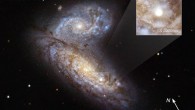
Astronomers using the NASA/ESA Hubble Space Telescope have captured an amazing new photo of the interacting galaxy system IC 1623. This Hubble image shows...

Jun 18, 2021 by Enrico de Lazaro

In a new study, astronomers used data from the NASA/ESA Hubble Space Telescope to calculate a more accurate distance to an ultra-diffuse galaxy called...

Jun 17, 2021 by News Staff

Betelgeuse, which is located roughly 724 light-years away in the constellation of Orion, is the second-closest red supergiant to Earth. From November 2019...

Jun 17, 2021 by News Staff

Using the Atacama Large Millimeter/submillimeter Array (ALMA), astronomers have detected a galactic-scale supermassive black hole-driven wind in HSC J124353.93+010038.5...

Jun 16, 2021 by News Staff

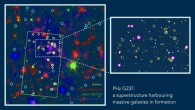
An international team of astronomers from the United States and the United Kingdom has made the discovery of a giant, almost symmetrical arc of galaxies...

Jun 16, 2021 by News Staff

Cosmic filaments are cylindrical tendrils of matter hundreds of millions of light-years across. In new research, published in the journal Nature Astronomy,...

Jun 15, 2021 by News Staff

According to new research by astronomers from the University of Oxford and University College London, the spin of the bar of our Milky Way Galaxy —...

Jun 14, 2021 by News Staff

Astronomers have performed photometric and spectroscopic observations of B2 1420+32, a blazar with a collection of ‘changing-look’ features. Sloan...

Jun 14, 2021 by Enrico de Lazaro

Astronomers using the NASA/ESA Hubble Space Telescope have taken a detailed image of a spectacular part of the spiral galaxy NGC 3254. This Hubble image...

Jun 11, 2021 by News Staff

Professional astronomers and citizen scientists from the NASA-funded Planet Hunters TESS project have discovered a two-planet system around the bright...

Jun 11, 2021 by News Staff

A giant star called VVV-WIT-08 exhibited a smooth, eclipse-like drop in brightness to a depth of 97% in 2012; minimum brightness occurred in April 2012...

Jun 11, 2021 by News Staff

The Canadian Hydrogen Intensity Mapping Experiment (CHIME) has detected 535 new fast radio bursts — including 18 repeating sources — during...

Jun 10, 2021 by Sergio Prostak

Astronomers using NASA’s Transiting Exoplanet Survey Satellite (TESS) have discovered a temperate, Neptune-sized planet orbiting the M-dwarf star TOI-1231. An...

Jun 9, 2021 by Enrico de Lazaro

A young open cluster called NGC 2516 has a classical tidal radius of 10 parsecs (33 light-years) and a halo of stars spanning at least 500 parsecs (1,600...

Jun 7, 2021 by Enrico de Lazaro

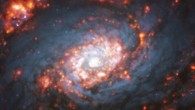
ESO has released a beautiful photo taken by the FOcal Reducer and low dispersion Spectrograph 2 (FORS2) on ESO’s Very Large Telescope (VLT) of the spiral...

Jun 7, 2021 by Enrico de Lazaro

The NASA/ESA Hubble Space Telescope has produced an outstanding image of the beautiful spiral galaxy NGC 4680. This Hubble image shows the spiral galaxy...

Jun 4, 2021 by News Staff

Long gamma-ray bursts are bright flashes of extragalactic gamma rays produced during the collapse of a massive star. A gamma-ray burst itself lasts only...

Jun 3, 2021 by News Staff

Astronomers using NSF’s Karl G. Jansky Very Large Array (VLA) have observed the fast-moving jet of material ejected by Cep A HW2, a massive protostar...

Jun 3, 2021 by Natali Anderson

Using astrometric, photometric and optical spectroscopy data from ESA’s Gaia mission and the 2MASS survey, astronomers have discovered a large, populous,...