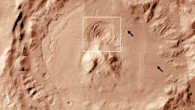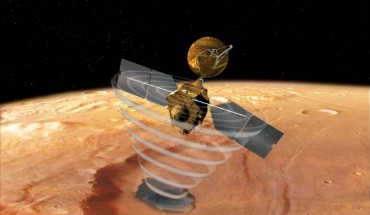
Frozen beneath Utopia Planitia, a large plain on Mars, lies about as much water as what’s in Lake Superior, according to an international team of planetary researchers. This image is an artist’s concept of a view looking down on NASA’s Mars Reconnaissance Orbiter. The spacecraft is pictured using its SHARAD instrument to ‘look’ under the surface of Mars. Image credit: NASA. Cassie Stuurman, a graduate student at the University of Texas Institute...
Planetary Science News