Space Exploration News

Apr 29, 2016 by News Staff

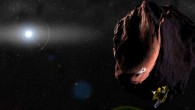
Observations of a tailless comet called C/2014 S3 (PanSTARRS), made with ESO’s Very Large Telescope and the Canada France Hawaii Telescope, show that it is the first object to be discovered on a long-period cometary orbit that has the characteristics of a pristine inner Solar System asteroid. Artist’s impression of C/2014 S3 (PanSTARRS). The comet’s current long orbital period (approximately 860 years) suggests that its source is in the Oort...

Apr 28, 2016 by News Staff

Ligeia Mare, one of the largest seas on Saturn’s moon Titan, consists of pure methane and likely has a seabed covered by a sludge of organic-rich material,...

Apr 26, 2016 by News Staff

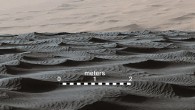
The Martian surface — including the location of ESA’s Beagle-2 lander, and the ancient lakebeds discovered by NASA’s Curiosity rover —...

Apr 23, 2016 by News Staff

Strong atmospheric gravity waves dominate the polar regions of Venus’ atmosphere, according to measurements made by ESA’s Venus Express spacecraft...

Apr 20, 2016 by News Staff

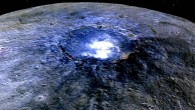
New images captured by NASA’s Dawn spacecraft from a distance of 240 miles (385 km) show two prominent craters on the surface of Ceres: Oxo and Haulani. This...

Apr 18, 2016 by News Staff

As Europa — the sixth-closest moon of Jupiter and the smallest of its four Galilean satellites — orbits, its icy surface heaves and falls with...

Apr 15, 2016 by News Staff

The NASA/ESA Cassini spacecraft has detected the faint but distinct signature of dust coming from outside our Solar System, from the Local Interstellar...

Apr 14, 2016 by Natali Anderson

Theoretical physicist Prof. Stephen Hawking and science philanthropist Yuri Milner unveiled this week a new initiative, called Breakthrough Starshot, to...

Apr 6, 2016 by News Staff

The bombardment of the Red Planet about 4 billion years ago (Noachian period) by giant comets and asteroids likely enhanced climate conditions enough to...

Apr 6, 2016 by News Staff

The Solar Wind Around Pluto (SWAP) instrument on NASA’s New Horizons spacecraft has recorded significant changes in how the solar wind behaves far from...

Mar 29, 2016 by Enrico de Lazaro

Planetary researchers on NASA’s Cassini mission have published a new study describing the process that drives and sustains long-lived geysers on Enceladus,...

Mar 28, 2016 by Enrico de Lazaro

Researchers on the AstRoMap project, a coordination action supported by the European Commission, have surveyed the state of the art of astrobiology in...

Mar 25, 2016 by News Staff

Planetary researchers with NASA’s Cassini mission have identified the highest point on Titan, the largest moon of Saturn. Titan’s Mithrim Montes is...

Mar 24, 2016 by News Staff

Earth’s moon wandered off its original axis about 3 billion years ago, a new study led by Southern Methodist University planetary researcher Matt Siegler...

Mar 22, 2016 by News Staff

Planetary researchers from NASA’s Dawn mission have released new images of the dwarf planet Ceres, including anticipated views of its intriguing ‘bright...

Mar 22, 2016 by News Staff

A team of researchers led by Dr. Antonio Genova of NASA’s Goddard Space Flight Center has released a detailed new map of Mars’ gravity. This view of...

Mar 18, 2016 by News Staff

Researchers on the New Horizons team have released a set of five scientific papers describing results from the July 2015 flyby of the Pluto system. This...

Mar 14, 2016 by News Staff

Members of the New Horizons mission team have discovered a huge ‘bite mark’ on the surface of the dwarf planet Pluto. ‘Bite mark’ on Pluto. The...

Mar 14, 2016 by News Staff

The ExoMars 2016 mission blasted off from Kazakhstan’s Baikonur Cosmodrome atop a Proton-M rocket at 02:31 a.m. PDT (05:31 a.m. EDT, 09:31 a.m. GMT,...

Mar 11, 2016 by News Staff

Tiny particles of stardust have been found in meteorites. Whether some of these particles, known as ‘pre-solar grains,’ came from classical novae is...