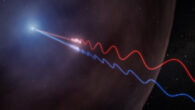
Using NSF’s Very Large Array (VLA), astronomers made the first radio detection of polarized light and Faraday rotation from a gamma-ray burst afterglow,...
New research indicates that Pluto’s largest moon, Charon, may continue to lose rotational energy despite the pair’s long-standing tidal lock, offering...
New research from Columbia University found that adults who cut their sleep by about 80 minutes for six weeks packed on a pound (0.45 kg) and moved less...
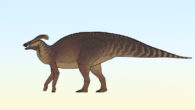
A new genus and species of lambeosaurine hadrosaurid dinosaur has been identified in southern Alberta, Canada, dating back 77 million years to the Campanian...
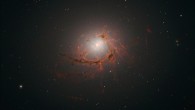
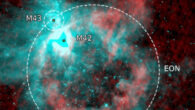
New images of the giant elliptical galaxy NGC 4696 from the NASA/ESA/CSA James Webb Space Telescope reveal gas filaments funneling material into a spinning...
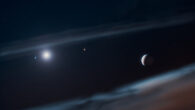
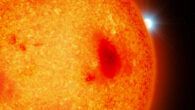
Using near-UV spectroscopic data from the Space Telescope Imaging Spectrograph (STIS) on the NASA/ESA Hubble Space Telescope, astronomers discovered four...
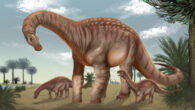
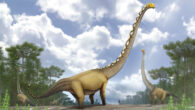
Paleontologists in Uruguay have identified a new species of aeolosaurine titanosaur from a pair of remarkably well-preserved tailbones unearthed in the...
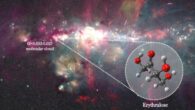
Using the Yebes 40-m and IRAM 30-m radio telescopes, astronomers have discovered erythrulose, a four-carbon sugar commonly found in raspberries and sunless...
For as long as readers have pored over Homer’s Odyssey they have pictured Ithaca, the homeland Odysseus fights for ten years to reach, as an island unto...
Slow-motion video reveals that buff-tailed bumblebees (Bombus terrestris) respond to sweet and bitter tastes with distinct, context-dependent behaviors...
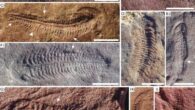
Spriggina floundersi, a marine species that lived during the Ediacaran period 550 million years ago, is one of Earth’s earliest bilaterally symmetrical...
Using the Karl G. Jansky Very Large Array (VLA) s and the Five-hundred-meter Aperture Spherical Radio Telescope (FAST), astronomers have created the sharpest-ever...
Paleontologists working in northeastern Thailand have identified a new species of mamenchisaurid sauropod dinosaur, offering fresh evidence that a group...
Using the upgraded GRAVITY+ instrument on ESO’s Very Large Telescope Interferometer (VLTI), astronomers have measured the ratio of carbon isotopes in...
Astronomers using ESA’s Euclid space telescope have discovered 31 ancient quasars from a time when the Universe was just 670 to 800 million years old....
On July 5, 2026, Japan Aerospace Exploration Agency’s Hayabusa-2 spacecraft completed the first asteroid encounter of its extended mission, flying past...