Astronomy News

Jan 18, 2024 by News Staff

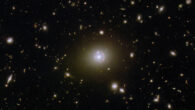
Astronomers using the NASA/ESA/CSA James Webb Space Telescope have detected a small and vigorous black hole in GN-z11, an exceptionally luminous galaxy that existed just 420 million years after the Big Bang, more than 13 billion years ago. That this black hole with a mass of a few million solar masses even exists so early in the Universe challenges current assumptions about how black holes form and grow. GN-z11, shown in the inset, is seen as it was...

Jan 17, 2024 by Enrico de Lazaro

Astronomers using CSIRO’s Australia Telescope Compact Array have captured the most detailed radio image ever seen of 47 Tucanae, the second brightest...

Jan 17, 2024 by News Staff

Intriguingly, the gamma-ray signal detected by NASA’s Fermi Gamma-ray Space Telescope is found in a similar direction and with a nearly identical magnitude...

Jan 15, 2024 by Enrico de Lazaro

Using NASA’s Transiting Exoplanet Survey Satellite (TESS), astronomers have spotted an Earth-sized planet transiting the young Sun-like star HD 63433. HD...

Jan 15, 2024 by Enrico de Lazaro

The NASA/ESA Hubble Space Telescope has taken a new picture of the relatively small galaxy UGC 5189A, which is found in the constellation of Leo. This...

Jan 10, 2024 by News Staff

A fast radio burst event called FRB 20220610A flashed in what seems like an unlikely place: a collection of at least seven galaxies that existed when the...

Jan 10, 2024 by News Staff

Dr. Christopher Stark from NASA’s Goddard Space Flight Center and his colleagues present new coronagraphic images from the NIRCam (Near-Infrared Camera)...

Jan 10, 2024 by Enrico de Lazaro

Astronomers using the NASA/ESA Hubble Space Telescope have detected massive cyclones and other dynamic weather activity swirling on WASP-121b, an ultrahot-Jupiter...

Jan 9, 2024 by News Staff

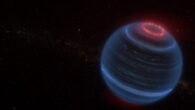
Using the NASA/ESA/CSA James Webb Space Telescope, astronomers have detected a brown dwarf with infrared emission from methane, likely due to energy in...

Jan 9, 2024 by News Staff

Odd radio circles (ORCs), a class of extragalactic astronomical sources discovered in 2019, are in fact shells formed by outflowing galactic winds, possibly...

Jan 8, 2024 by News Staff

New research suggests that the Green Monster — a curious structure first spotted in Webb data in April 2023 — came from that blast wave slamming...

Jan 8, 2024 by Enrico de Lazaro

This cosmic encounter is known as Arp 122 and is seen here as imaged by the NASA/ESA Hubble Space Telescope. Two spiral galaxies, NGC 6040 and NGC 6039,...

Jan 5, 2024 by News Staff

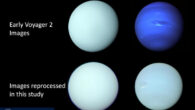
Uranus and Neptune, the so-called ice giants, are the most distant giant planets in our Solar System. Our knowledge of these worlds was revolutionized...

Jan 5, 2024 by News Staff

30 Doradus B, also cataloged as NGC 2060, is found in the Large Magellanic Cloud, a small satellite galaxy of the Milky Way. At the center of this complex...

Jan 1, 2024 by Enrico de Lazaro

A new infrared image, taken with the Wide Field Camera 3 (WFC3) on board the NASA/ESA Hubble Space Telescope, shows dozens of galaxies — including...

Dec 29, 2023 by News Staff

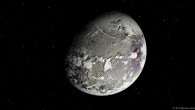
Planets too close to their star are too hot (such as Venus), those too far, are too cold (like Mars), whereas planets in the habitable zone are just right....

Dec 28, 2023 by News Staff

A new movie from NASA’s Fermi mission shows the intensity of gamma rays — the highest-energy form of light — with energies above 200 million...

Dec 28, 2023 by Enrico de Lazaro

Neutron-star cores contain matter at the highest densities in our Universe. This highly compressed matter may undergo a phase transition where nuclear...

Dec 27, 2023 by Enrico de Lazaro

There are more than 200 moons in our Solar System, but their relatively small sizes make similarly sized extrasolar moons (exomoons) very hard to detect...

Dec 26, 2023 by Enrico de Lazaro

Astronomers using the Atacama Large Millimeter/submillimeter Array (ALMA) have observed a disk bending wave in BRI 1335-0417, the oldest known spiral galaxy...