Astronomy News

Dec 16, 2016 by News Staff

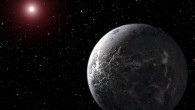
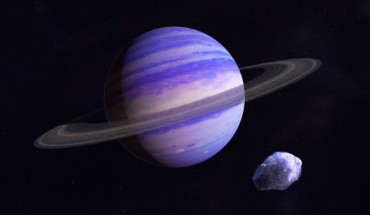
A new statistical study of exoplanets found by an innovative technique called gravitational microlensing suggests that so-called ‘cold Neptunes’ are likely the most common type of planet to form in the icy outer regions of extrasolar planetary systems. Neptune-mass planets like the one shown in this artist’s rendering may be the most common in the icy regions of planetary systems; beyond a certain distance from a young star, water and other...

Dec 15, 2016 by News Staff

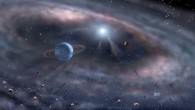
Astronomers have used the Atacama Large Millimeter/submillimetre Array (ALMA) to observe the early stages in the formation of a new star system. For the...

Dec 13, 2016 by News Staff

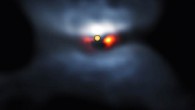
Astronomers using the Atacama Large Millimeter/submillimeter Array (ALMA) have found compelling evidence that two infant planets — each about the...

Dec 12, 2016 by News Staff

ASASSN-15lh, an extremely bright explosion in a massive galaxy 3.82 billion light-years away, was thought to be the most luminous supernova ever seen....

Dec 12, 2016 by News Staff

Signs of powerful changing winds have been detected on an extrasolar gaseous planet called HAT-P-7b, which is 40% larger than Jupiter and orbits a star...

Dec 12, 2016 by Natali Anderson

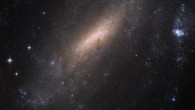
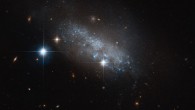
The NASA/ESA Hubble Space Telescope has produced an incredibly detailed image of IC 5201, a galaxy in the southern constellation of Grus. This Hubble image...

Dec 9, 2016 by News Staff

Astronomers have used CSIRO’s Australia Telescope Compact Array (ATCA) and NASA’s Chandra X-ray Observatory to show that a recently-discovered lensed...

Dec 8, 2016 by News Staff

A team of astronomers has discovered a giant object — an enormous, Jupiter-like exoplanet or a low-mass brown dwarf — orbiting an ageing red...

Dec 7, 2016 by News Staff

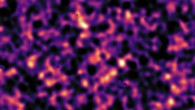
An international research team led by Dr. Massimo Viola from the Leiden Observatory and Dr. Hendrik Hildebrandt from the Argelander-Institut für Astronomie...

Dec 5, 2016 by Enrico de Lazaro

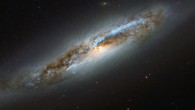
The NASA/ESA Hubble Space Telescope has taken a colorful photo of NGC 4388, an active spiral galaxy at the core of the Virgo Cluster. This image from the...

Dec 3, 2016 by Enrico de Lazaro

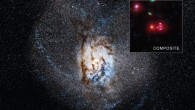
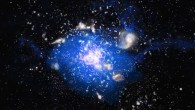
Massive galaxies may grow from cold molecular gas that condenses as stars rather than forming in violent mergers, according to an international team of...

Dec 2, 2016 by News Staff

Grant Mathews, professor of theoretical astrophysics and cosmology in the University of Notre Dame’s College of Science, believes the event that led...

Dec 1, 2016 by News Staff

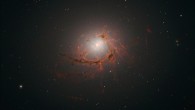
The NASA/ESA Hubble Space Telescope has captured the most detailed image yet of NGC 4696, an unusual looking galaxy with a bright core wrapped in a system...

Dec 1, 2016 by News Staff

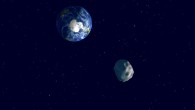
An international team of astronomers led by University of Arizona scientist Dr. Vishnu Reddy has obtained observations of the smallest near-Earth asteroid...

Nov 30, 2016 by News Staff

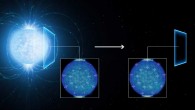
By studying the light emitted from the very dense and strongly magnetic neutron star RX J1856.5-3754, a team of astronomers has found the strongest observational...

Nov 29, 2016 by News Staff

A low-mass core-collapse supernova catalyzed the birth of our Solar System, according to a team of scientists led by University of Minnesota researcher. Planets...

Nov 28, 2016 by Enrico de Lazaro

A team of astronomers in Japan has conducted the first ground-based transit observation of K2-3d, a super-Earth within the habitable zone around a bright...

Nov 28, 2016 by News Staff

This NASA/ESA Hubble Space Telescope image shows the galaxy IC 3583, which lies in the constellation of Virgo, approximately 27.8 million light-years away. This...

Nov 21, 2016 by News Staff

A research team led by California Institute of Technology astronomer Vikram Ravi and Curtin University research fellow Ryan Shannon has detected the brightest...

Nov 21, 2016 by Enrico de Lazaro

Astronomers have identified a new ultra-faint dwarf satellite companion of our Milky Way Galaxy. A schematic showing the locations of Virgo I and other...