Space Exploration News
Sep 26, 2014 by News Staff

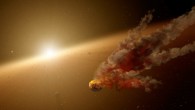
Half of the water on our planet predates the formation of the Sun, according to a groundbreaking study carried out by a team of researchers from the United States and the UK. An illustration of water in our Solar System through time from before the formation of the Sun through the creation of the planets. Image credit: Bill Saxton / NSF / AUI / NRAO. Water is found throughout the Solar System. Not just on Earth, but on icy comets and moons, and in...

Sep 25, 2014 by News Staff

NASA’s MAVEN spacecraft – the first spacecraft dedicated to exploring the upper atmosphere of Mars – has returned its first pictures...

Sep 22, 2014 by News Staff

On September 21, 2014, NASA’s Mars Atmosphere and Volatile Evolution (MAVEN) spacecraft successfully entered the orbit of the Red Planet after completing...

Sep 20, 2014 by News Staff

Brown University planetary scientists in a new study have found that tidal heating is the main reason responsible for the present appearance of Miranda...

Sep 17, 2014 by News Staff

A team of scientists from the United Kingdom and Greece led by Dr Elias Chatzitheodoridis of the National Technical University of Athens has found a mysterious...

Sep 15, 2014 by News Staff

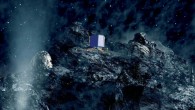
The European Space Agency’s Rosetta mission has picked a location on Comet 67P/Churyumov–Gerasimenko where it aims to land the Rosetta’s lander,...

Aug 25, 2014 by News Staff

On August 25, 1989, NASA’s Voyager 2 spacecraft passed within about 40,000 km of Triton, the largest moon of the planet Neptune. In commemoration...

Aug 22, 2014 by News Staff

Paleosols (ancient fossilized soils) filling the Yellowknife Bay geologic formation within the 3.7-billion-year-old Gale Crater on Mars are strong evidence...

Jul 29, 2014 by News Staff

A team of U.S. researchers using data from NASA’s Cassini spacecraft has discovered 101 active geysers erupting on Enceladus, the sixth-largest moon...

Jul 21, 2014 by News Staff

Oceans are crucial for supporting Earth-like life on extrasolar planets, according to a study published in the journal Astrobiology. Artist’s concept...

Jul 18, 2014 by News Staff

A group of planetary scientists using data from the Thermal Emission Imaging System (THEMIS) onboard NASA’s Mars Odyssey orbiter has created the most...

Jul 9, 2014 by News Staff

A multinational team of researchers led by Dr Nathalie Cabrol of NASA Ames Research Center and the SETI Institute has recorded an unprecedented level of...

Jul 9, 2014 by News Staff

Voyager 1 spacecraft has been hit by a ‘shock wave’ from the Sun as it travels through interstellar space, according to NASA scientists. Voyager 1....

Jul 6, 2014 by News Staff

A detailed analysis of gravity and topography data from Titan, the largest moon of Saturn, provides strong evidence that the ocean inside the moon might...

Jun 30, 2014 by News Staff

After several weather delays, engineers from NASA’s Low-Density Supersonic Decelerator project have successfully tested a flying saucer-shaped spacecraft...

Jun 24, 2014 by News Staff

A new study provides strong evidence that the nitrogen in the atmosphere of Titan – the largest of the Saturn’s known 62 moons – originated...

Jun 23, 2014 by News Staff

A team of planetary researchers, led by Jason Hofgartner of Cornell University, has announced the discovery of an anomalous, bright geologic object –...

Jun 15, 2014 by News Staff

The chemistry of the smoggy atmosphere of the Saturn’s largest moon, Titan, has been successfully simulated by NASA researchers in lab experiments. This...

Jun 14, 2014 by News Staff

Charon – the largest moon of the dwarf planet Pluto – may once have had a warm subterranean ocean, suggests a team of planetary scientists led...

Jun 10, 2014 by News Staff

Engineers and scientists from NASA’s Low-Density Supersonic Decelerator project are about to test a new technology for landing heavy payloads on...