By analyzing nickel isotopes preserved in the 66-million-year-old debris left by the Chicxulub impact, researchers conclude that the asteroid responsible...
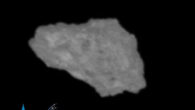
On July 2, 2026, the Tianwen-2 probe closed to within 20 km (12.4 miles) of the small near-Earth asteroid 2016 HO3, one of only seven Earth quasi-satellites...
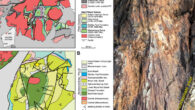
Zircon crystals and impact-altered minerals show that a massive asteroid slammed into what is now the Pilbara region of Western Australia about 3 billion...
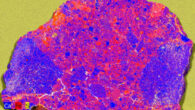
Planetary scientists analyzing a lunar meteorite known as Northwest Africa (NWA) 12593 have uncovered evidence of an asteroid impact that occurred 3.5...
By combining seismic, gravity and topographic data, a team of researchers from Italy, Switzerland, Germany and the United Kingdom found that several well-known...
The Northwest Africa (NWA) 12774, an angrite meteorite discovered in the Sahara Desert, likely in Mauritania, appears to be a fragment of a vanished protoplanet,...
An international research team led by scientists from the University of Bonn, the University Hospital Bonn and the Max Planck Institute of Animal Behavior...
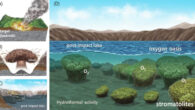
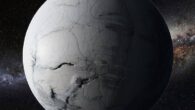
Earth experienced extreme climate swings during the Neoproterozoic epoch (one billion to 538.8 million years ago), including the Sturtian glaciation, when...
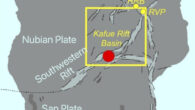
Unusual gases rising from geothermal springs within the Kafue Rift of Zambia suggest a deep fracture in Earth’s crust could mark the early stages of...
New research reveals that 3.4 billion years ago (Archean Eon), ancient microbes relied on molybdenum — a metal that was vanishingly rare at the time...
A new statistical analysis of archival sky surveys from the early Cold War has found that mysterious, short-lived bursts of light in the night sky were...
A new analysis of isotopic signatures across planets and meteorite parent bodies suggests our home world formed entirely from inner solar system material,...
Long thought to be fueled by increased atmospheric oxygen concentration, enormous griffinflies from the Carboniferous period, 300 million years ago, may...
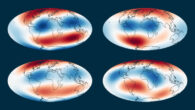
By tracing magnetic signals preserved in 3.5-billion-year-old rocks in Western Australia, geoscientists have found the oldest direct evidence yet that...
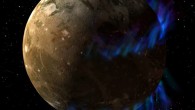
Scientsts from the United States, Europe and China have used the Ultraviolet Spectrograph (UVS) onboard NASA’s Juno spacecraft to map detailed patch...
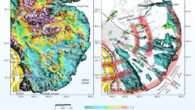
New research by geoscientists from the University of Florida and the Institut de Physique du Globe de Paris traces the origins of the Antarctic gravity...
A new analysis of exquisitely preserved laminated rocks (varves) from the Port Askaig Formation on the Garvellach Islands, Scotland, shows that climate...
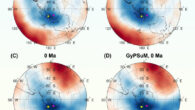
Two immense, ultrahot rock structures located at the base of Earth’s mantle, around 2,900 km beneath Africa and the Pacific, have been shaping Earth’s...